
Language
Please Choose Your Language
Views: 222 Author: Amanda Publish Time: 2025-11-29 Origin: Site


Content Menu
● What Is An Auto Tilt Patio Umbrella?
● Key Components Of An Auto Tilt Umbrella
● How The Auto Tilt Mechanism Works
● Auto Tilt Vs. Other Tilt Mechanisms
● Advantages Of Auto Tilt Patio Umbrellas
● Design Challenges And Possible Weak Points
● Best Scenarios For Using Auto Tilt Umbrellas
● Safe Operation Of Auto Tilt Patio Umbrellas
● Maintenance Tips For Auto Tilt Mechanisms
● OEM Considerations For Auto Umbrella Manufacturing
● FAQs
>> 1. How is an auto tilt umbrella different from a standard patio umbrella?
>> 2. Is an auto tilt umbrella safe to use in windy conditions?
>> 3. How long does an auto tilt mechanism usually last?
>> 4. Can an auto tilt umbrella be repaired if the tilt stops working?
>> 5. What size auto tilt umbrella is best for my patio table?
An auto tilt patio umbrella is an outdoor Auto Umbrella that combines a crank lift with an integrated tilt mechanism inside the pole or hub so both functions are controlled from the same handle. When the user cranks the handle, the canopy first opens vertically; once fully open, further cranking engages the tilt mechanism and the upper section of the umbrella leans to one side.[2][6]
This type of Auto Umbrella is especially popular for patios, decks, poolside areas, and restaurant terraces where the sun angle changes during the day and users need quick, fine shade adjustment. Instead of moving furniture or bases, a small twist of the crank repositions the canopy, which makes the Auto Umbrella attractive for both residential and commercial installations.[4][6]
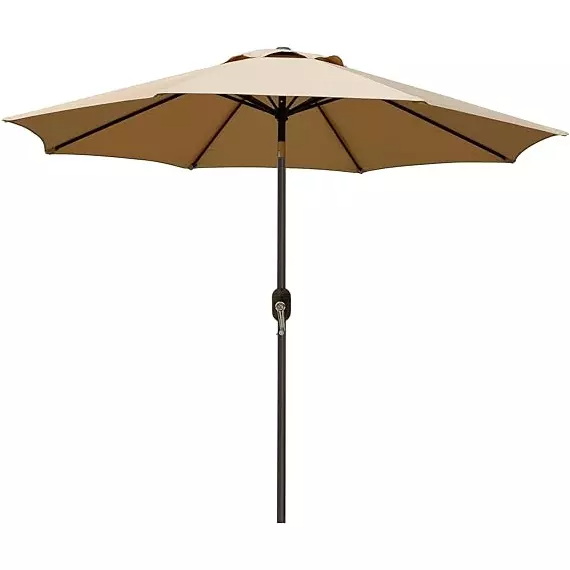
Although it looks simple from the outside, an auto tilt patio umbrella hides several coordinated mechanisms inside the pole and hub. Each component contributes to the smooth opening and automatic tilting that defines this style of Auto Umbrella.[2][4]
Typical key components include:[4][2]
- Canopy and ribs
- The fabric canopy, often polyester, acrylic, or solution‑dyed performance fabric, is stretched over ribs that open and close as the Auto Umbrella is cranked.
- Ribs and stretchers transmit force from the central hub to the canopy, creating a taut surface for shade.
- Main pole
- The main shaft is usually aluminum or steel, often in two sections connected by a threaded coupling or similar joint.[2][4]
- Inside this pole, a cable or cord runs from the crank mechanism to the sliding hub that lifts the Auto Umbrella canopy.
- Crank handle and gearbox
- The crank handle sits at a comfortable height near the lower part of the Auto Umbrella pole.
- A compact gearbox converts rotational motion into linear movement of the internal cable, reducing the effort needed to raise a large canopy.
- Hub, runner, and sliders
- The hub connects the ribs, while a runner (or slider) travels up the pole as the Auto Umbrella opens.
- When the runner reaches the top, the canopy is fully open and the system transitions from lifting mode to tilting mode.
- Tilt joint or cam system
- Above the hub or within the upper section of the pole, a hinge, cam, or similar joint allows the Auto Umbrella head to tilt.
- Continued cranking after full opening activates this joint, changing the angle between the upper and lower pole without additional user actions.[6][2]
From the user's perspective, the auto tilt Auto Umbrella works through a single, continuous crank motion, but internally there are two distinct phases: opening and tilting. The mechanism relies on the way the cable tension and mechanical stops are arranged along the pole.
The basic working sequence is:[6][2]
1) Opening phase
- The user turns the crank clockwise, which draws the cable and pulls the runner upward.
- The runner pushes the ribs outward from the center, causing the Auto Umbrella canopy to expand until the ribs are fully extended.
2) Locking at full open
- Once the canopy reaches its designed open position, the runner or hub hits a stop, and the lifting motion is complete.
- At this point, the Auto Umbrella stands upright, and the crank feels slightly firmer as the system prepares to tilt.
3) Transition to tilt
- When the user continues cranking past this point, the internal geometry changes so the tension no longer lifts the canopy but instead acts on the tilt joint.
- A cam or linking rod inside the Auto Umbrella head gradually pulls or pushes the upper pole section out of alignment with the lower section.
4) Automatic tilting
- The top section of the Auto Umbrella pole begins to lean, and the canopy tilts to one side to block low‑angle sunlight.
- The tilt angle usually increases smoothly until it reaches a preset maximum, often around 20–30 degrees, depending on the model.[6][2]
5) Returning upright and closing
- Turning the crank in the opposite direction straightens the tilt joint first, bringing the Auto Umbrella canopy back to vertical.
- Continuing to crank counter‑clockwise lowers the runner, folding the ribs toward the pole and closing the umbrella for storage.
This clever coordination between lifting and tilting is what allows the Auto Umbrella to behave as if it had two mechanisms but only one visible control.
Auto tilt is one of several tilt styles found on modern patio umbrellas, and understanding these differences helps customers decide which Auto Umbrella is best for their space. Other common systems include push‑button, collar, and manual crank tilt.
The main tilt types can be summarized as follows:[4][6]
- Push‑button tilt
- A button near the hub unlocks a hinge; the user must physically push the canopy into a tilted position.
- This design is simple and affordable but requires reaching up, which can be inconvenient when the Auto Umbrella is mounted through a table.
- Collar tilt
- A rotating collar above the crank is twisted to tilt the canopy, while a separate crank or rope lifts and lowers the Auto Umbrella canopy.
- This gives good control but still involves two separate actions.
- Crank tilt (non‑auto)
- Some umbrellas use a crank to open, then need a separate motion or step to engage tilt.
- These models may not feel as seamless as a full Auto Umbrella because the tilt action is not fully automatic.
- Auto tilt
- The same crank lifts and then tilts automatically once the Auto Umbrella is fully open, with no extra buttons or collars.
- For many users, this offers the best balance of convenience, aesthetics, and ease of operation.
Compared with other formats, the Auto Umbrella minimizes visible hardware and keeps the user interaction extremely simple, which is helpful in hospitality venues where staff must quickly adjust multiple umbrellas.
Auto tilt patio umbrellas offer several practical advantages for both home users and commercial operators. For OEM buyers, these benefits translate into strong selling points and higher perceived value for each Auto Umbrella model.
Key advantages include:[2][4]
- Convenience
- Only one handle controls opening, closing, and tilting, making the Auto Umbrella intuitive even for first‑time users.
- Guests do not need to stand on tiptoe or reach above their heads to change the shade angle.
- Better shade throughout the day
- As the sun moves, small adjustments to the crank angle allow the Auto Umbrella to keep seating areas shaded in the morning, midday, and late afternoon.
- This reduces the need to drag heavy bases or move furniture to follow the sun.
- Clean appearance
- The internal tilt mechanism is hidden inside the Auto Umbrella pole, resulting in a neat, uncluttered silhouette.
- Fewer external controls also mean less visual distraction on premium terraces, cafés, and hotels.
- Strong market appeal
- Many retail and project customers view the Auto Umbrella as a functional upgrade over basic market umbrellas, supporting premium positioning and price.
- The "automatic" feel differentiates Auto Umbrella collections and encourages repeat business for shade solutions.
Despite their benefits, auto tilt umbrellas introduce some engineering challenges that manufacturers and OEM customers must consider. The moving parts that make an Auto Umbrella so convenient can also become failure points if not properly designed and maintained.
Common issues and challenges include:[4][2]
- Increased mechanical complexity
- Extra gears, cables, and joints mean more parts that must be precisely manufactured, assembled, and tested.
- If tolerances are too loose, the Auto Umbrella crank can feel rough or the tilt may not hold its position.
- Wear at the tilt joint
- The tilt hinge experiences repeated bending as users adjust the Auto Umbrella, especially in sunny climates where tilting is frequent.
- Inferior materials or thin wall sections can crack or deform over time, leading to sagging or misalignment.
- Wind load on tilted canopies
- When the Auto Umbrella is tilted, one side catches more wind, increasing stress on the joint, ribs, and pole.
- Users who leave umbrellas open in strong wind can overstress the mechanism and cause premature failure.
- Repair and servicing
- Internal cable or gearbox issues can be difficult to repair at home, and replacement often requires manufacturer‑supplied parts.
- This makes high‑quality components and strong after‑sales support important for any Auto Umbrella program.
Auto tilt umbrellas are most effective where the angle of the sun varies significantly relative to the seating area, and where moving furniture is inconvenient. Selecting the right environment helps users get full value from an Auto Umbrella investment.
Typical best‑use scenarios include:[6][4]
- Dining tables with central umbrella holes
- An Auto Umbrella can stay fixed in the table while tilting provides adequate shade across all seats.
- This configuration is ideal for family patios, cafés, and bistros.
- Poolside and lounge areas
- Placing an Auto Umbrella between loungers allows guests to adjust tilt without standing up or moving chairs.
- The directional shade also helps protect against sun exposure while reading or relaxing.
- Balcony and small patios
- In tight spaces, there is rarely room to shift the base; tilting the Auto Umbrella is the most efficient way to follow the sun.
- Compact auto tilt sizes fit well with two‑ and four‑chair balcony sets.
- Commercial terraces
- Waitstaff can quickly crank multiple Auto Umbrella units to keep guests comfortable as the sun moves, without interrupting meals.
- This can improve customer satisfaction and extend the usable hours of outdoor seating.
Safe and correct operation is essential to protect both users and the Auto Umbrella itself. Simple habits greatly reduce the risk of damage, especially in locations prone to wind or sudden storms.
Basic safety guidelines include:[4][6]
- Use a suitable base
- Choose a base weight appropriate for the canopy diameter and expected wind conditions.
- A stable base prevents tipping and reduces stress on the Auto Umbrella pole and joints.
- Open and tilt gradually
- Turn the crank smoothly and avoid sudden, forceful movements when the Auto Umbrella transitions to tilt.
- If the handle becomes unusually hard to turn, stop and check for obstructions rather than forcing it.
- Avoid strong wind
- Always close the Auto Umbrella in high winds, thunderstorms, or when leaving the area for long periods.
- This is especially important when the canopy is tilted, as leverage on the joint increases significantly.
- Secure when not in use
- Tie the closed canopy with the integrated strap or a cover to prevent flapping and abrasion.
- For seasonal properties, store the Auto Umbrella indoors during long off‑season periods.
Regular maintenance keeps the auto tilt mechanism smooth and prolongs the life of the Auto Umbrella. These steps are easy to perform and can be incorporated into seasonal outdoor care routines.
Recommended maintenance practices include:[6][4]
- Cleaning
- Wipe the pole and hub with a mild detergent solution and soft cloth, avoiding harsh abrasives that can damage finishes.
- Rinse carefully so no soap residue remains on the Auto Umbrella hardware or canopy.
- Inspection
- Periodically check for loose screws, bent ribs, frayed cable, or cracks around the tilt joint.
- If the Auto Umbrella shows signs of misalignment, address the issue before further use.
- Lubrication
- Apply a light, weather‑resistant lubricant to moving joints and the crank area according to manufacturer guidance.
- Avoid lubricating fabric or plastic components that are not designed for contact with oils.
- Canopy care
- Brush off loose dirt and spot‑clean stains promptly to maintain the Auto Umbrella's appearance.
- If the canopy is removable, some fabrics can be gently washed according to their care instructions.
For brands, wholesalers, and project buyers, specifying an Auto Umbrella for OEM production involves careful decisions on structure, materials, and features. A well‑engineered auto tilt line can become a core product in a patio and garden assortment.
Important OEM considerations include:[2][4]
- Structure and dimensions
- Typical residential Auto Umbrella sizes include 8–11 ft (around 2.4–3.3 m) round or octagonal canopies, with pole diameters around 1.5–1.9 inches.[2][4]
- Matching canopy size to pole strength and base weight is essential for both safety and durability.
- Materials and hardware
- Powder‑coated aluminum or steel poles resist corrosion and match modern outdoor furniture aesthetics.
- High‑quality metal housings, braided steel cables, and reinforced hubs improve the Auto Umbrella's long‑term performance.[2]
- Fabric choices
- UV‑resistant performance fabrics maintain color and strength under sun exposure and are a key selling point for premium Auto Umbrella models.
- Offering multiple color ranges and pattern options supports both retail and contract markets.
- Mechanism quality and testing
- Life‑cycle testing that repeatedly opens, tilts, and closes the Auto Umbrella under load helps ensure reliability.
- Clear assembly and usage instructions reduce misuse and warranty claims.
By integrating these factors into design and sourcing, an OEM Auto Umbrella program can deliver products that satisfy both end users and professional buyers.
Auto tilt patio umbrellas combine a crank lift with an internal tilt joint so users can open, angle, and close the canopy through one simple control, without push buttons or manual hinges. This Auto Umbrella design offers flexible shade, a clean appearance, and convenient operation for patios, balconies, poolside areas, and commercial terraces.
For OEM customers, focusing on robust materials, well‑engineered mechanisms, and thoughtful sizing ensures that each Auto Umbrella delivers smooth tilting, reliable performance, and a comfortable experience over many seasons. With proper selection, safe use, and regular maintenance, an auto tilt patio umbrella becomes a long‑lasting centerpiece of outdoor living.
An auto tilt umbrella uses a single crank to both open the canopy and tilt it, while a standard patio umbrella usually only opens and closes without integrated tilt. In many standard models, users rely on separate push‑button or collar mechanisms, but the Auto Umbrella design combines everything into a smooth, automatic sequence.[6][2]
Auto tilt umbrellas are intended for light to moderate breezes and should always be closed during strong winds, storms, or when left unattended. Because a tilted Auto Umbrella catches more wind, closing and securing it is the safest way to avoid tipping, bending, or damage to the tilt joint and base.[4][6]
The lifetime of an auto tilt mechanism depends on the quality of the pole, cable, gears, and joints, as well as how the Auto Umbrella is used and maintained. With good materials, correct base sizing, and basic cleaning and lubrication, many auto tilt umbrellas provide several years of reliable service in residential settings.[6][2]
Some minor issues, such as loose screws or a slightly misaligned crank, can be fixed by the user, but internal cable or gear failures usually require professional service or replacement parts. For this reason, choosing an Auto Umbrella from a supplier that offers spare parts and technical support is important, especially for commercial applications.[4][2]
As a general guideline, the canopy of an Auto Umbrella should extend roughly 2–3 feet (0.6–1 m) beyond the table edge on all sides to provide effective shade. For most 4–6 person round or square tables, this often means selecting an 8–10 ft auto tilt umbrella with a compatible, properly weighted base.[4][6]
[1](https://terraoutdoor.com/products/auto-tilt-11-market-umbrella-black-frame)
[2](https://patioumbrellastore.com/9-round-deluxe-auto-tilt-patio-umbrella.php)
[3](https://linqcdn.avbportal.com/documents/e7d7b48b-cade-498d-a4d4-eea4da74f52d.pdf)
[4](https://www.homedepot.com/p/Pure-Garden-10-ft-Aluminum-Outdoor-Market-Patio-Umbrella-with-Auto-Tilt-Easy-Crank-Lift-in-Sand-HW1500074/307669459)
[5](https://www.patiowell.com/products/motorized-remote-market-umbrella)
[6](https://blog.curranonline.com/patio-umbrella-buying-guide-everything-you-need-to-know/)
[7](https://www.aosom.com/item/3-tier-auto-tilt-patio-umbrella-with-crank-system-8-ribs-support-outdoor-market-table-pool-deck-umbrella-116-l-x-116-w-x-98~1UUF23AT43G00.html)


