
Language
Please Choose Your Language
Views: 222 Author: Amanda Publish Time: 2025-11-25 Origin: Site


Content Menu
● Ancient Origins: The Umbrella's Early History
● The Leap Toward Portability: European Innovations
● Early Foldable and Collapsible Concepts
● The Pocket and Folding Umbrella Revolution
>> The Balogh Brothers in Hungary
>> The Telescopic Pocket Umbrella: Hans Haupt and Knirps
>> Slawa Duldig (Horowitz): The "Flirt" and Female Innovation
>> The American Breakthrough: Bradford E. Phillips
● The Anatomy of the Folding Umbrella
● Modern Styles and Consumer Trends
● Market Growth and Global OEM Manufacturing
● Sustainability and the Next Generation
● Cultural Impact: More Than Rain Protection
● Frequently Asked Questions (FAQ)
>> 1. Who invented the folding umbrella?
>> 2. How does a folding umbrella work?
>> 3. What are the main types of folding umbrellas?
>> 4. Why is the folding umbrella so popular globally?
>> 5. What trends are shaping the future of folding umbrellas?
The folding umbrella—an indispensable companion for commuters and travelers worldwide—combines elegant portability with practical engineering, making it a striking example of functional invention and cultural adaptation. Its story spans art, design, resilience, and commerce, as the device evolved from large wooden canopies to today's pocket-sized weather shields. For manufacturers, OEM partners, and global suppliers, the journey of the folding umbrella showcases an inspiring tradition of continuous improvement and innovation.[1][2][3][4][5][6]
Long before the folding umbrella transformed urban living, umbrellas themselves symbolized status, shelter, and sophistication. Ancient civilizations such as Egypt, Assyria, Greece, Rome, India, and especially China, all boast records of fixed-frame umbrellas as essential tools—primarily to protect from the sun. Early Chinese umbrellas, developed as far back as 3500 years ago, were crafted from mulberry bark or bamboo frames topped with oiled paper, silk, or feathers, suitable for both sunshade and rain.[3][5][1]
These designs spread along trade routes to neighboring kingdoms, with aesthetic modifications such as lacquered finishes and elaborate tassels. In the West, Greek and Roman citizens used parasols as both status symbols and practical accessories, later evolving into decorative, fabric-covered models that adorned noblewomen throughout the Middle Ages.[8][9][3]
Despite ongoing refinements, umbrellas remained cumbersome and rarely foldable for centuries. The pivotal change came in early 18th-century France, when Parisian merchant Jean Marius introduced a lightweight, folding umbrella in 1701/1710. Marius's device, featuring a collapsible wooden or whalebone frame and fabric canopy, could be opened and closed—light enough to be carried with ease. Its popularity soared, and King Louis XIV granted Marius exclusive production rights for several years, igniting usage among Parisian elites and setting new standards for portability.[4][9][1][3]
By the late 18th and 19th centuries, British umbrella makers further advanced portable designs with innovations like steel ribs (invented by Samuel Fox in 1852), waterproofed silk canopies, and ergonomic handles. London retail pioneers such as James Smith & Sons capitalized on these changes, establishing umbrellas as everyday accessories for both men and women.[2][5][4]
Various inventors in Europe and America experimented with collapsible umbrellas in the 19th century. In 1885, John Van Wormer, an American, patented a ribbon-holder collapsible umbrella but couldn't bring it to market at scale, so his idea had little impact at the time. Meanwhile, advances in waterproof fabric and lighter metal frames made more portable umbrellas conceivable, but true compact folding remained elusive.[5][2]
The journey to the modern folding umbrella accelerated in 1923, when the Balogh brothers, based in Uraiújfalu, Hungary, patented the "pocket" or truly foldable umbrella. Their umbrella, utilizing an innovative jointed shaft and rib structure, could be neatly collapsed into a portable package. The design quickly gained recognition in Europe, with patents granted in Austria, Germany, Belgium, France, the UK, Poland, and the US.[3][5]
Building on these advances, German inventor Hans Haupt created the first "telescopic" folding umbrella in 1928—enabling the entire shaft and ribs to collapse into a handheld pouch. Haupt's product, launched under the brand name "Knirps" (meaning "little one"), set new standards for compactness and reliability. Knirps umbrellas became so popular that "knirps" soon became a generic German word for any mini folding umbrella, cementing their influence across Europe and beyond.[6][1][4][5]
Concurrently, in Vienna, artist and designer Slawa Duldig (née Horowitz) envisioned an even more practical folding umbrella. Frustrated with rain-soaked commutes, she devised an umbrella that could fit in her handbag: a telescopic shaft, folding ribs, and a compact profile. Duldig earned a patent in September 1929, and her "Flirt" umbrella was soon produced by Austrian and German manufacturers. Her brilliant design became a sensation at the Vienna Spring Fair, representing pioneering female ingenuity in industrial design.[3]
By the mid-20th century, umbrella technology leaped forward with new materials and techniques. In 1969, American inventor Bradford E. Phillips refined the concept further, securing a patent for a highly durable, truly "working" folding umbrella—commercialized by Totes Incorporated in Loveland, Ohio. Phillips's inventions featured aluminum and, later, fiberglass frames, robust mechanisms, and canopies made of water-resistant synthetic fabrics. These solutions established the template for the modern folding umbrella as known today.[1][5][6]
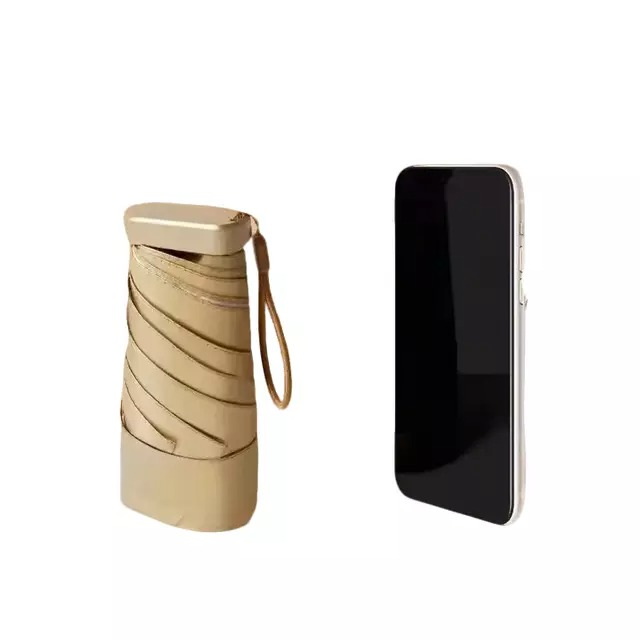
Folding umbrellas are engineering marvels in miniature. Their core components typically include:
- Telescopic or multi-jointed shaft for compact collapse and easy extension[4][6]
- Foldable ribs (two-fold, three-fold, or more) accommodating compact storage[6]
- Springs, latches, and a sliding runner for reliable deployment and closure
- Lightweight yet weather-resistant canopies—ranging from Teflon-coated polyester to transparent vinyl
- Ergonomic, often non-slip, handles for comfort and convenience
Advancements in CNC machining, plastics molding, and precision metallurgy have allowed manufacturers and OEMs to enhance the durability and refinement of folding umbrellas, offering products resistant to wind, heavy rain, and daily wear.
- Three-fold umbrellas are the most widespread, striking a balance between compactness and canopy width.
- Five-fold umbrellas are remarkable for ultra-short length but trade some durability for portability.[6]
- Automatic opening and closing mechanisms, windproof frames with reinforced joints, UV-protective coatings, and customizable artwork have expanded market offerings.
- Design is also key: fashion umbrellas, branded giveaways, and technological novelties (such as self-drying and reverse-folding models) appeal to a broad demographic.[6]
The folding umbrella is not merely a consumer good; it's a global commodity shaped by OEM partnerships and mass production expertise. Chinese, Japanese, and Southeast Asian manufacturers now lead world umbrella output, producing custom designs and private-label solutions for leading brands, wholesalers, and retail chains.
OEM clients benefit from:
- A variety of frame and canopy fabric options
- Customization of shapes, printing, and corporate branding
- Scalable production runs, competitive pricing, and global distribution
Modern factories harness automation and precision quality control, ensuring that even affordable folding umbrellas meet stringent safety and durability standards. For international brands, partnerships with OEM suppliers empower local adaptation, rapid response to design trends, and fast delivery even for high-volume orders.
With environmental awareness rising, sustainability is increasingly shaping folding umbrella production:
- Use of recycled nylon, polyester, and aluminum in canopies and frames
- Eco-friendly dyes and water-based coatings
- Designs enabling easier repair and longer product life
- Projects for recycling broken umbrellas into new goods
This trend enables brands and OEM factories to appeal to conscious consumers and contribute to the circular economy.
The folding umbrella has permeated popular culture. It is celebrated in literature, film, and advertising—as a symbol of preparedness, urban life, and adaptability. Certain cities, like Tokyo, are known for the ubiquity of clear folding umbrellas, while in London and Paris, designer models often make fashion statements. For millions, the folding umbrella also serves as a reminder of innovation's role in meeting daily challenges simply and elegantly.
The folding umbrella's journey from ancient parasol to modern urban essential is a chronicle of ingenuity, resilience, and global teamwork. Driven by the visions of inventors like Jean Marius, Samuel Fox, the Balogh brothers, Hans Haupt, Slawa Duldig, and Bradford E. Phillips, the folding umbrella has become an irreplaceable accessory for every wardrobe, rainstorm, or sunbeam life might deliver. As manufacturing technology and design continue to evolve, OEM partnerships remain vital to fulfilling diverse consumer needs around the world.[2][5][1][4][3][6]

The development of the folding umbrella involved several key inventors. Jean Marius of Paris pioneered a lightweight folding design in 1701/1710, but it was the Balogh brothers in Hungary (1923), Hans Haupt in Germany (1928, "Knirps" telescopic umbrella), and Slawa Duldig in Vienna (1929, handbag-size "Flirt") who brought the true compact folding umbrella to modern markets. Bradford E. Phillips of the USA patented the durable "working" folding umbrella in 1969.[5][1][2][4][3][6]
A folding umbrella uses telescopic or multi-jointed shafts and foldable ribs so the whole device can be collapsed to a portable package. Pressing a button or sliding a runner deploys the umbrella, popping the canopy open and securing it with spring-loaded latches.[4][6]
Types include two-fold, three-fold, and five-fold models, with three-fold the most popular and five-fold offering the smallest packed size. There are also windproof, UV-proof, and fashion variants to meet diverse needs.[6]
Its compactness, portability, affordable prices, diversity of designs, and the ability to personalize make the folding umbrella a favorite across varied climates and cultures.[6]
Sustainability (recycled and greener materials), repairability, and advanced engineering for durability are key. Smart features—like UV detection, IoT connectivity, and self-drying coatings—are also emerging, with global OEM partners driving rapid adaptation.
[1](https://www.beau-nuage.fr/en/module-blog?id=8)
[2](https://umbrellaheaven.com/complete-history-of-umbrellas/)
[3](https://en.wikipedia.org/wiki/Umbrella)
[4](https://www.umbrellaworkshop.com/umbrellas/history-of-the-umbrella/)
[5](https://historycooperative.org/when-was-the-umbrella-invented/)
[6](https://www.thecottonlondon.com/pages/history-and-types-of-umbrella)
[7](https://www.promoleaf.com/blog/history-of-umbrellas)
[8](https://artsandculture.google.com/story/umbrellas-over-time-inpi/twXxaW0okvtpKw?hl=en)
[9](https://www.pens.com/uk/blog/umbrella-history-invention/)


